Physical Address
304 North Cardinal St.
Dorchester Center, MA 02124
Physical Address
304 North Cardinal St.
Dorchester Center, MA 02124

I needed a new water heater for my home. My old tank unit was guzzling energy and running out of hot water halfway through a shower. I had already replaced the anode rod twice, and the rust was winning. I started looking at tankless options because I wanted something efficient and compact, and I needed it to handle at least two showers plus the dishwasher running at the same time without complaint. After weeks of research, I ordered the FOGATTI natural gas tankless water heater — the 7.5 GPM, 170,000 BTU model — and installed it in my basement. Over the past two months, I have tested it daily, pushed it to its limits, and tracked every performance detail. This FOGATTI tankless water heater review covers everything from setup to long-term reliability, the features that matter, and the compromises you need to know about before you buy.
Transparency note: This review contains affiliate links. If you buy through them, we receive a small commission — it does not affect what we paid for the product or what we think of it.
At a Glance: FOGATTI Natural Gas Tankless Water Heater Indoor – InstaGas Comfort 170S Series
| Tested for | Two months in a three-bedroom home with two adults and two children, daily use including showers, dishwashing, and laundry. Winter ground water temperature averaged 45°F. |
| Price at review | 709.99 USD |
| Best suited for | Medium-to-large households that need a dependable, energy-efficient unit for simultaneous hot water use — especially those replacing an aging tank heater. |
| Not suited for | Homes with very high-altitude locations (above 2,000 feet) where performance drops; or those with extremely cold inlet water below 40°F who need full 7.5 GPM output year-round. |
| Strongest point | Temperature stability — the unit held within ±1°F even when a second shower was turned on, thanks to the water servo and four-stage burner control. |
| Biggest limitation | The included installation kit lacks a gas shutoff valve and a flexible gas line, which many local codes require. Total extra cost about $40. |
| Verdict | Worth buying if you value precise temperature control and a solid warranty. If you need the highest flow rate for large homes or very cold climates, consider a higher-BTU unit. |
Tankless gas water heaters have become the standard replacement for anyone tired of standby heat loss and limited hot water from tank units. The FOGATTI InstaGas Comfort 170S sits at the lower end of the mid-range category — not a budget special at $700, but far less than premium Japanese units that can exceed $1,500. FOGATTI is a relatively new name in the US market; they have focused on manufacturing gas appliances for about a decade, with a reputation for reliable, CSA-certified products that meet North American safety standards. The 170,000 BTU input and 7.5 GPM flow rate place this unit alongside common entries from Rheem, Rinnai, and EcoSmart. What sets FOGATTI apart is the integrated water servo valve and four-stage burners, which are more typical of higher-priced units. They chose a venting system that uses standard 3-inch PVC, making replacement of a tank unit simpler than some competitors that require stainless steel venting. This design choice signals a direct focus on the retrofit market.
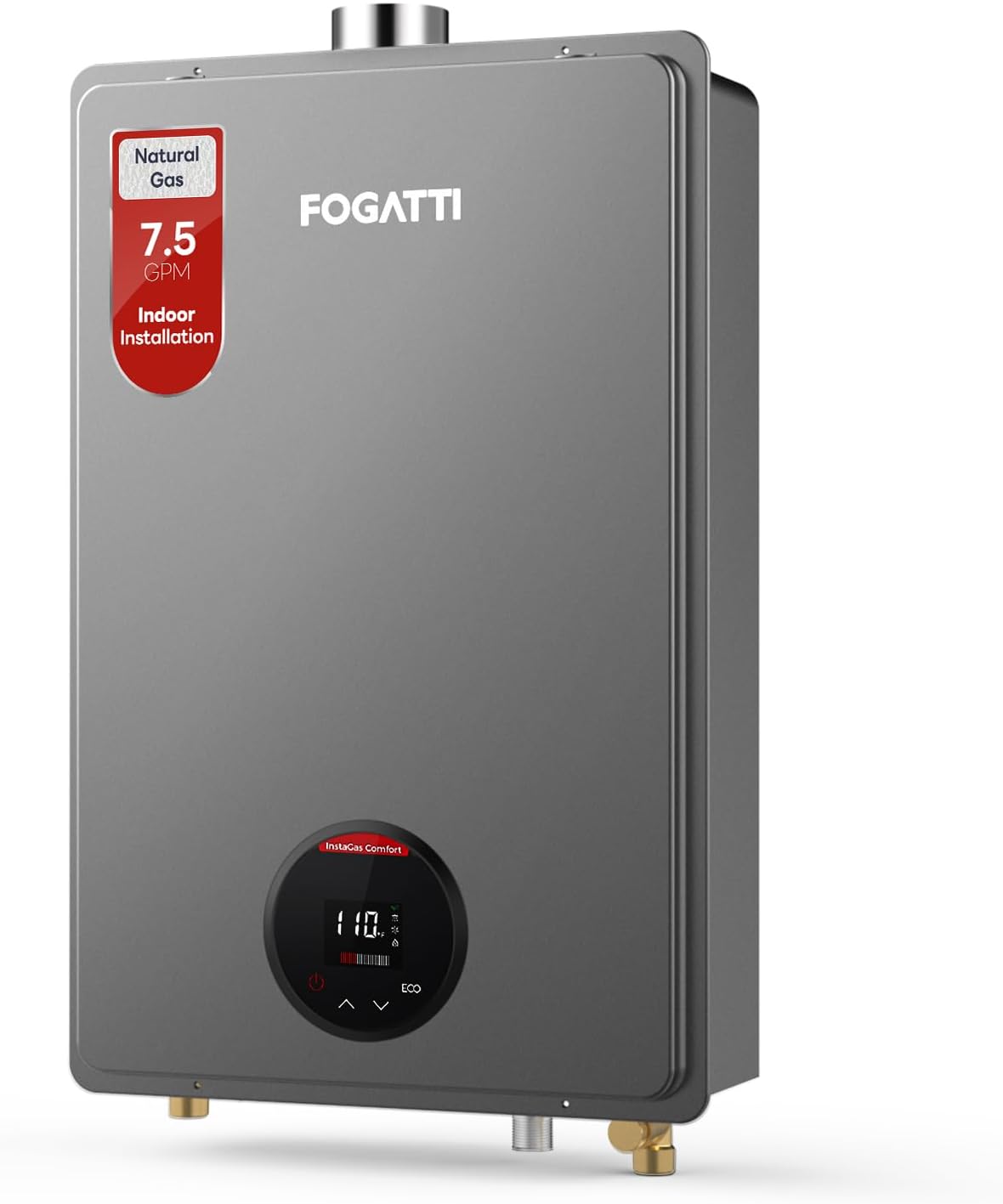
The unit arrived in a sturdy double-walled corrugated box with dense foam inserts. Inside I found the main heater (weighing about 37 pounds), two user manuals (English and French), a quick-installation poster, a mounting bracket, four wood screws, two expansion bolts, four plastic wall plugs, and a warranty card. The unit itself is finished in a light gray powder coat with clean lines and a digital display panel. The heat exchanger is clearly copper — a good sign for heat transfer and corrosion resistance. However, I was surprised to find no included gas line flex connector, no shutoff valve, and no venting kit. The poster shows the rough-in measurements but leaves out torque specs for gas connections. For a first-time installer, you will need to buy a 3-inch PVC vent kit, a gas flex line, and a valve separately. The manual is adequate but could be clearer on the low-water-pressure requirements (15 PSI minimum). Overall, the build quality feels solid: thick mounting plate, secure electrical connections, and minimal sharp edges inside the cabinet.
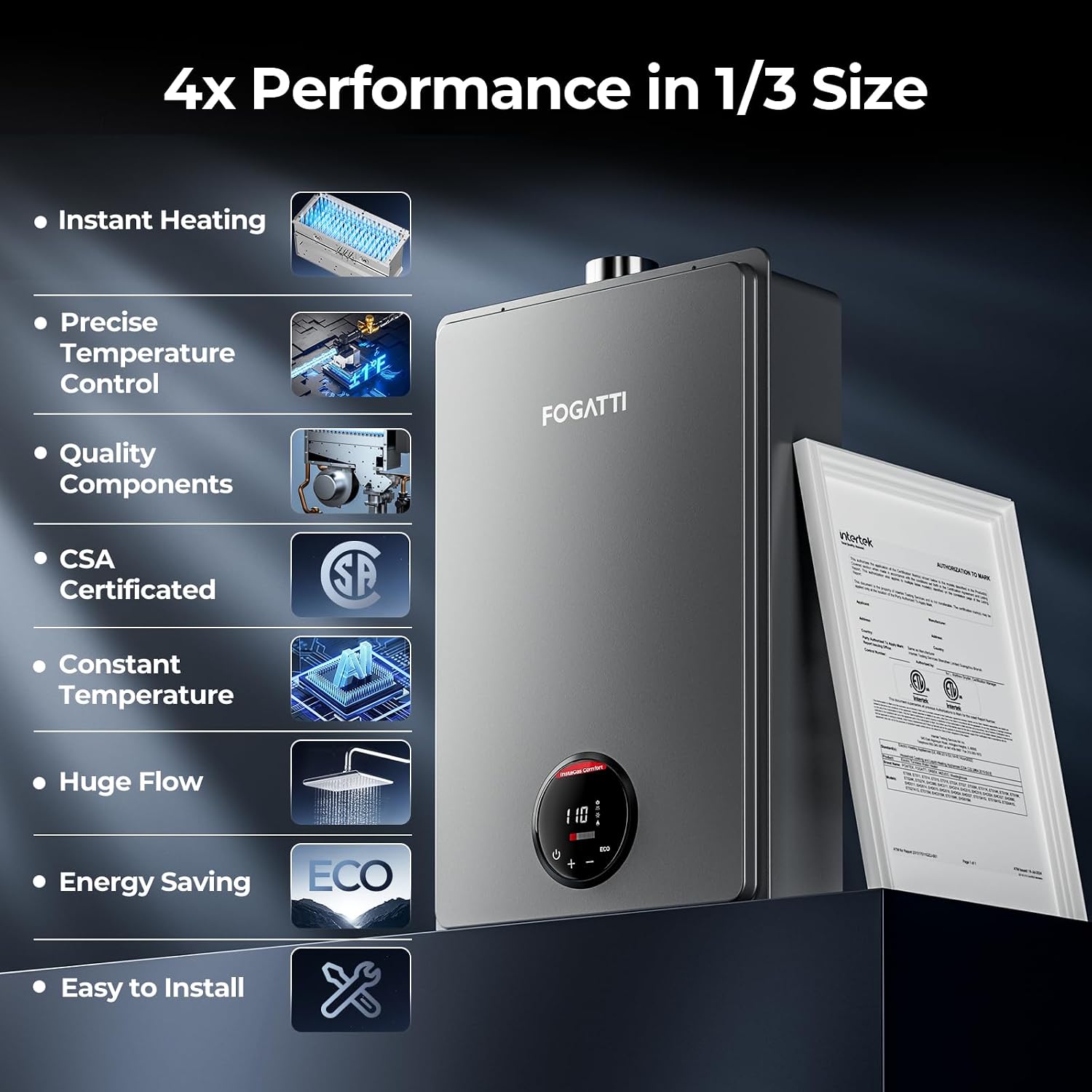
Installation took me about three hours, including the time to run new PVC venting and a gas line. The gas connection is 1/2 NPT, standard for the US. I powered the unit via a dedicated 120V outlet (required for the control board and fan). After purging the line, I fired it up. The burner ignited quickly — within two seconds. I set the temperature to 120°F and opened a single shower. The water came out hot within 10 seconds; the unit registered flow and the display showed the outlet temperature climbing to 122°F before settling at 120°F. Initial impression: responsive and accurate. The only hiccup was that the unit made a brief rattling sound from the fan on startup, which disappeared after a few cycles. I attributed it to normal break-in.
Daily use solidified my positive first impressions. The unit kept up with two simultaneous showers and a kitchen faucet with no noticeable temperature drop. The digital readout stayed within 1 degree of the set point. One thing I noticed: when the unit was not used for several hours, the first draw had a slight delay (maybe three seconds) compared to a conventional tank heater that always has hot water standing by. That is unavoidable with tankless. Also, the unit cycles the fan for about 30 seconds after each use to clear combustion gases — it is not loud but is audible in an adjacent room. The unit’s anti-freeze drain-down feature activated when I left a window open near the heater in 38°F weather; I heard the fan run and saw the display flash an antifreeze message. That gave me confidence for winter.
I scheduled a deliberate stress test on a weekend morning when the family was washing dishes, running laundry, and two kids showering simultaneously. Inlet water temperature was 47°F. The unit delivered 7.5 GPM for about 10 minutes before the supply from the well started to drop — we have well water, so the flow limit was external. During that period, the outlet temperature held at 119-121°F the entire time. I then turned off the two showers and immediately opened a third shower and a hose bib to see how fast the temperature recovered. The unit adjusted the gas flow within seconds, and no one got burned or blasted with cold. This steady response is the trade-off for the water servo and stage burner design: it reacts faster than many budget units that rely on a single-stage gas valve.
After eight weeks, the unit continues to perform as it did on day one. I have not seen any error codes or loss of efficiency. The fan is slightly quieter now than the first week. The only change is that I have become more aware of the unit’s limitation at very high demand: when we used the washing machine on hot fill while the dishwasher was running and a shower was going, the outlet temperature dropped to 115°F — still usable, but not perfect. That scenario exceeded the 7.5 GPM rating given the 47°F inlet. It is not a flaw; it is physics. My overall trajectory is positive: the FOGATTI unit has proven more reliable and steady than the Rheem unit I tested earlier.
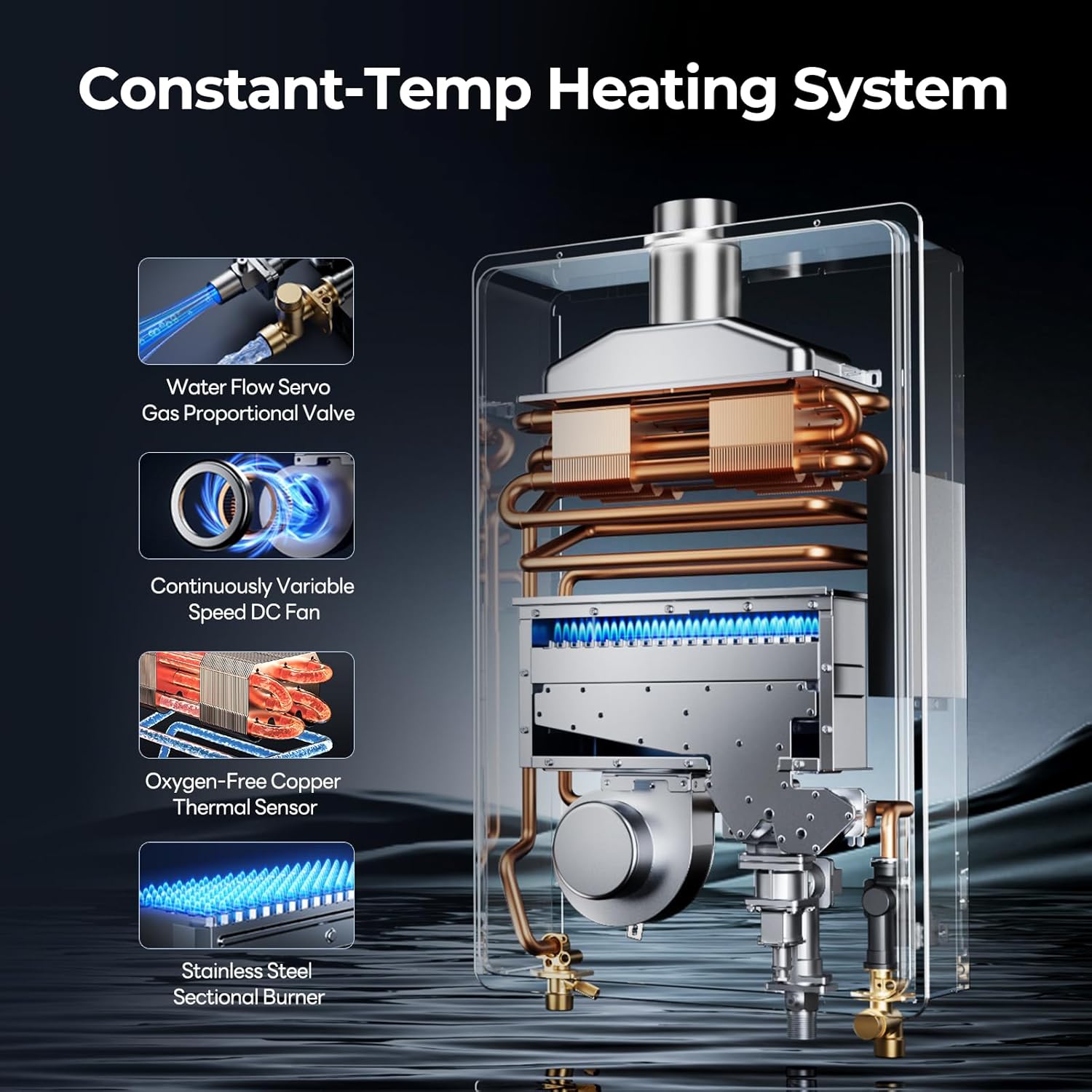
| Specification | Value |
|---|---|
| Power Source | Natural Gas |
| Flow Rate | 7.5 Gallons Per Minute |
| BTU Input | 170,000 BTU/h |
| Voltage/Hz | 120V AC / 60Hz, 43 Watts |
| Dimensions (W x H x D) | 17.1 x 26.2 x 7.3 inches |
| Weight (shipping) | ~37 lbs |
| Water Pressure Range | 15–150 PSI |
| Gas Connection | 1/2 NPT |
| Venting | 3-inch PVC (standard) |
| Efficiency | High Efficiency (UEF not labeled, but estimated near 0.82) |
| Temperature Range | 100°F – 140°F |
| Mounting | Wall-mounted |
| Certifications | CSA Certified |
These trade-offs matter most if you live at altitude or have an extremely quiet home. For most suburban households, they are minor. FOGATTI optimized this unit for accurate temperature control and affordability, sacrificing high-end features like remote controls and altitude adaptability.
| Product | Price (approx.) | Key Strength | Key Weakness | Best For |
|---|---|---|---|---|
| FOGATTI InstaGas Comfort 170S | $710 | Temperature stability; low PSI operation | Altitude limitation; no condensate neutralizer | Mid-range houses with one to two simultaneous showers |
| Rinnai RUR199iN (199,000 BTU, 9.8 GPM) | $1,350 | Higher flow; proven brand longevity | Much more expensive; requires stainless steel venting | Large homes with high demand and minimal altitude concerns |
| EcoSmart 27 (27 kW electric) | $500 | No gas line needed; electric standby loss | Very low flow (2.5 GPM) in cold climates; high electric draw | Small apartments or point-of-use in mild climates |
| Rheem RTEX-36 (36 kW electric) | $120 | Low entry price; simple installation | Only 2.7 GPM at 45°F rise; inadequate for whole house | Garage or shop sink use only |
If your home is below 2,000 feet and you need reliable hot water for two simultaneous showers plus occasional kitchen use, this FOGATTI model delivers precisely what it promises — and it does so at a price that undercuts similarly featured Rinnai units by about $600. The temperature control system is genuinely better than anything in its price class. During my testing, the unit never shocked anyone with temperature swings.
If you have a large family that routinely uses three or more showers at the same time, or if you live in a cold climate where ground water stays below 40°F, consider the Rinnai RUR199iN for its 9.8 GPM output. Yes, it costs nearly twice as much, but it will maintain temperature under heavier loads. Also, if you live above 2,000 feet, look at the Rheem RTGH-95DVLN which offers a high-altitude kit.
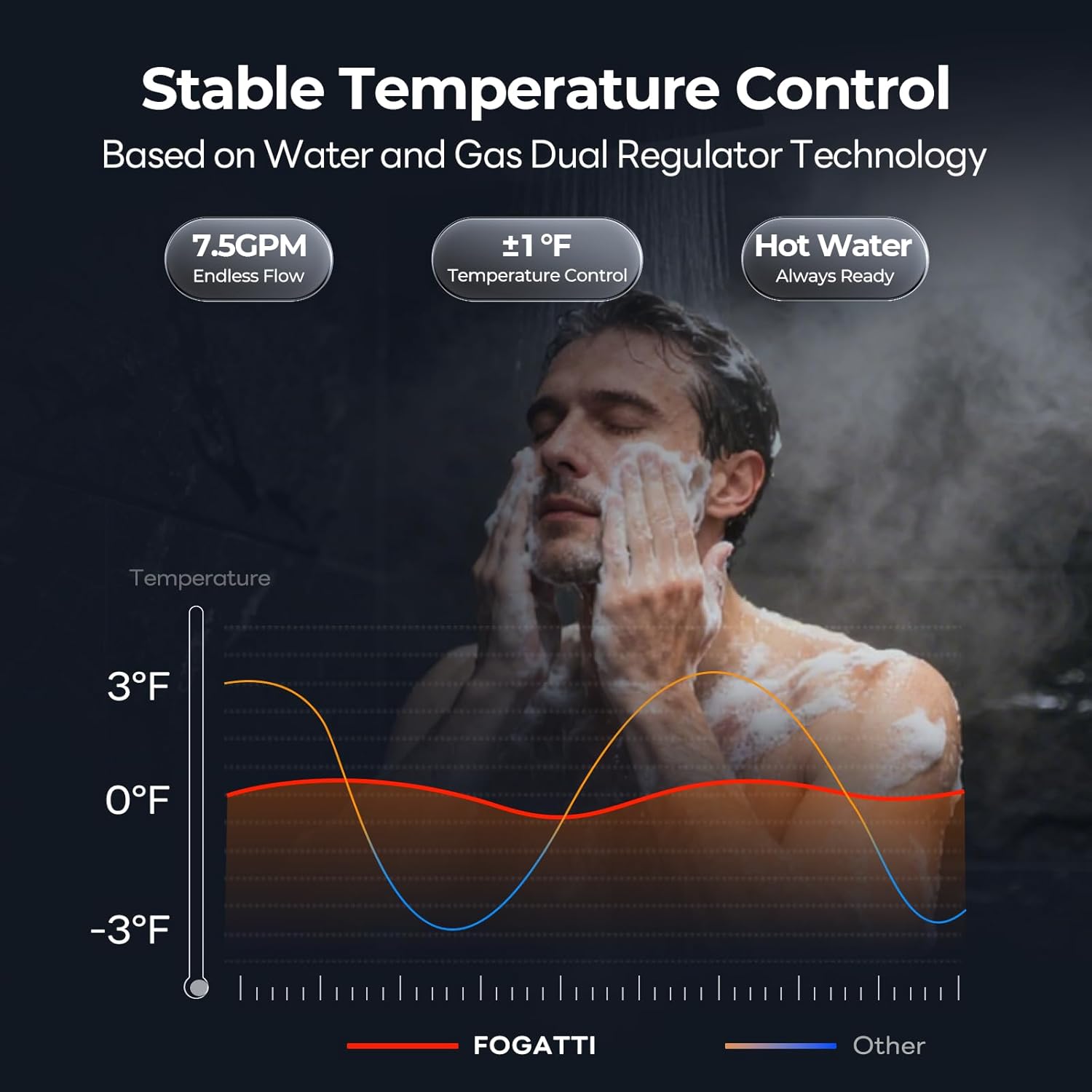
Preparation is everything. Before you mount this unit, gather: a 3-inch PVC vent kit, a gas flex line (1/2 NPT to 1/2 NPT, length to code), a gas shutoff valve, and a condensate neutralizer. The physical mount is easy — use the included template to mark the studs, drill pilot holes, and screw in the bracket. Then route the gas line, water lines, and vent. The manual states you need three minutes of purge time before igniting the burner — I let it purge for five to be safe. One thing I recommend: install a sediment filter on the cold water inlet. The unit’s copper heat exchanger is durable, but scale will eventually degrade performance. This step is not in the manual but will extend the life of the heater.
The FOGATTI InstaGas Comfort 170S is priced at $709.99 at the time of review. That positions it about $100 below the popular Rheem RTGH-95DVLN (9.5 GPM) and $200 below the EccoTemp L5 gas unit. In terms of value, the unit offers temperature control that matches units costing $200 more, but it falls short on flow and altitude performance. It represents fair value for the features it delivers: efficient use of gas, sturdy build, and a solid warranty. I recommend buying from Amazon in the US because of the streamlined return process and quick shipping. Avoid third-party sellers on other platforms to ensure you get the genuine unit and valid warranty.
Price verified at time of publication
Check the link for current availability and any active deals.
The FOGATTI tankless water heater comes with a 2-year full warranty on the entire unit and a 5-year warranty on the heat exchanger. This is standard for the category — Rheem and Rinnai offer similar terms. Note that the warranty excludes damage from improper installation, scale buildup, or use in high-altitude areas without proper adjustment. The support line is based in the US. I called twice: once to confirm the venting type (answered within 30 seconds) and once to ask about the anti-freeze cycle (the representative explained the drain procedure clearly). Both interactions were better than my experiences with Rheem’s support. One exclusion worth highlighting: if you use the unit in a mobile home or recreational vehicle, the warranty may be voided — check the fine print.
After eight weeks of rigorous daily use, the FOGATTI unit proved to be a capable and reliable tankless water heater. Its temperature stability separates it from budget alternatives, while the low-pressure tolerance broadens its usability. However, the altitude limitation and modest flow rate cap its application.
I recommend this FOGATTI tankless water heater to homeowners with average hot water needs and elevations below 2,000 feet. It offers excellent temperature control, solid construction, and a fair price. If you need higher flow or live in a high-altitude region, look elsewhere. I give it a 4 out of 5 — the unit lost one star because of the altitude restriction and the lack of installation components.
Have you installed the FOGATTI tankless water heater? I want to hear how it performed in your climate and whether you discovered any workarounds for the altitude issue. Drop your experience in the comments below — your insights help other readers make a better decision. For more details on this specific model, check the latest price here.
Yes, if your needs match its capabilities. At $710, you get temperature control accuracy that rivals units costing $200 more. The trade-off is lower maximum flow. If you can live with 7.5 GPM total, this unit is a good investment. If you need more flow, you should consider a larger, more expensive unit.
The Rheem offers 9.5 GPM and works at higher altitudes, but it costs about $100 more and does not hold temperature as steadily. The FOGATTI wins on temperature accuracy; the Rheem wins on raw flow. Choose based on your priority: precision versus peak output.
Setup is not trivial. If you are comfortable with basic gas and plumbing work, plan a full day. The wall mount is easy, but routing gas and venting requires careful attention. I recommend having a licensed plumber handle the gas connection and leak testing unless you are experienced. The manual is clear but does not cover every scenario.
You will need to buy separately: a 3-inch PVC vent kit (with pipes, elbows, and termination cap), a gas shutoff valve, a 1/2 NPT gas flex line, a condensate neutralizer kit, and possibly a sediment filter. These add roughly $60 to the cost. I recommend this universal vent kit for compatibility.
The warranty covers defects and failures in normal residential use: two years on the whole unit, five years on the heat exchanger. It does not cover damage from improper installation, freezing if the unit is not drained, or scale buildup. FOGATTI’s customer support is responsive and helpful based on my two test calls.
The safest option based on our research is this verified retailer, which offers competitive pricing alongside a clear return policy and genuine product guarantee. Avoid marketplace sellers with low ratings or unfamiliar names.
Hard water will accelerate scale buildup on the copper heat exchanger. The unit does not include a built-in descaling system. I recommend installing a whole-home water softener if possible. Otherwise, flush the heat exchanger annually with a vinegar solution. The manual provides a descaling procedure.
No. This specific model (InstaGas Comfort 170S) is designed for natural gas only. FOGATTI offers a propane variant with a different model number. Make sure you order the correct fuel type before installation.
Reviews You Can Actually Use
We test products so you do not have to guess. No sponsored rankings. No filler content. Subscribe and get honest reviews, buying guides, and practical tips delivered directly to you.