Physical Address
304 North Cardinal St.
Dorchester Center, MA 02124
Physical Address
304 North Cardinal St.
Dorchester Center, MA 02124

I bought my first countertop distiller six years ago because I got tired of carrying five-gallon jugs of distilled water from the grocery store for my CPAP machine and my espresso setup. The small batch units I tried were fine for two quarts at a time, but they required constant attention. Refill the boiling chamber, wait four hours, empty the collection jug, start again. I needed something that could keep up with daily demand without hovering. That is what led me to test the H2OMATIC automatic water distiller, specifically the 5-gallon-per-day model with a 3-gallon reserve tank. I have been running it for seven weeks in my home office, filling everything from my countertop ice maker to my portable humidifier, and this H2OMATIC water distiller review covers what I found. I will walk through setup, performance quirks, trade-offs, and whether the price tag makes sense for your situation. If you are looking for a reliable automatic water distiller that can run unattended for days, read on.
Transparency note: This review contains affiliate links. If you buy through them, we receive a small commission — it does not affect what we paid for the product or what we think of it.
Before I get into the details, I should mention that I have also reviewed other home water treatment solutions on this site, including the Kind Water Systems E3000UV, which takes a different approach with UV filtration. That context matters because distillation and UV filtration serve different water quality needs, and I want you to understand where the H2OMATIC fits.
At a Glance: H2OMATIC Automatic Water Distiller (5 Gallons/Day, 3-Gallon Reserve)
| Tested for | 7 weeks of continuous daily use in a home office, producing water for CPAP, humidifier, espresso machine, and occasional drinking water. |
| Price at review | 2195USD |
| Best suited for | Households that need a steady supply of distilled water for multiple appliances, CPAP users, or anyone who wants to stop hauling jugs from the store. |
| Not suited for | Countertop-only use with zero tolerance for noise during distilling cycles, or those needing distilled water for medical-grade use requiring certification. |
| Strongest point | The automatic fill and shut-off system actually works reliably — I did not have a single overflow or dry-run in seven weeks. |
| Biggest limitation | The 30-pound weight and the need for a dedicated counter space larger than a typical microwave make placement harder than expected. |
| Verdict | Worth buying if you use more than two gallons of distilled water weekly and have the counter space — the automation eliminates the main frustration of batch distillers. |
Distillation is the most straightforward way to remove dissolved solids, heavy metals, and biological contaminants from tap water. The process is simple — boil water, capture the steam, condense it back to liquid — but the market has bifurcated into two categories. On one side, you have small countertop batch distillers that produce one to four quarts per cycle and cost $100 to $300. On the other, you have plumbed-in automatic systems that can produce five to twelve gallons daily but often cost $1,500 or more and require permanent installation. The H2OMATIC automatic water distiller review that follows focuses on the model that straddles these two worlds. It is a countertop unit that can produce five gallons per day, holds a three-gallon reserve, and runs on automatic sensors instead of manual timers. That combination places it in a narrow slice of the market. The manufacturer, H2OMATIC, has been making water distillation equipment for over a decade. Among experienced users — particularly off-grid homeowners and water-quality hobbyists — the brand is known for using 304 stainless steel in the boiling chamber and condenser, which avoids the metallic taste that cheaper aluminum units impart. The design choice to include six carbon filter pods and a jar of descaling cleaner in the box signals that H2OMATIC expects their customers to maintain the unit. That matters more than you might think, as scale buildup is the primary failure point for most distillers.
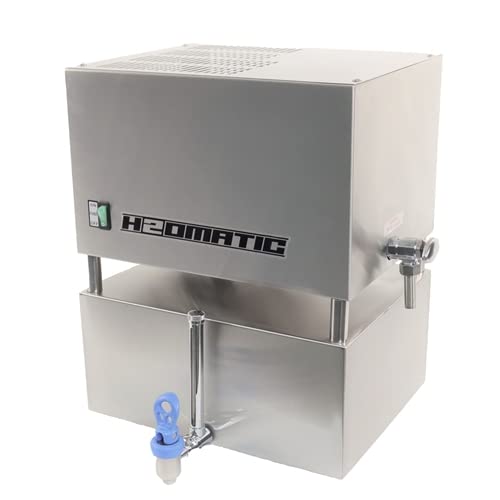
The box is large — roughly 20 by 18 by 22 inches — and the unit itself weighs 30 pounds, so expect a heavy delivery. Inside, the packing material is dense foam that holds the main body securely. The contents include the distiller unit with the stainless steel boiling chamber and condenser assembly, the three-gallon reserve tank (which attaches to the main unit via a clear hose), six activated carbon filter pods, one jar of descaling cleaner, a pre-filter attachment for the water inlet, and a printed installation guide. The documentation is minimal but functional. What is missing from the box is a faucet adapter for the inlet hose — the unit comes with a standard garden-hose thread fitting, so if your kitchen sink has a threaded aerator, you will need an adapter that I had to buy separately. The first physical impression is that H2OMATIC uses a heavier gauge of stainless steel than most competitors. The boiling chamber wall feels substantial, and the lid seals with a hinged clamp that requires some force to close. The unit is not polished to a mirror finish — it has a brushed surface that should hide fingerprints better than glossy alternatives.
Setup took about 25 minutes. The main challenge was finding a spot where the unit could sit within reach of an incoming water supply and a drain. The instructions recommend a dedicated faucet connection, but I used a Y-splitter on my existing sink supply line. Filling the boiling chamber for the first time requires lifting the lid, pouring in about two gallons by hand, then closing the clamp. That is awkward because the unit is heavy and the lid hinge is stiff. Once filled, the unit began heating the water. The first distillation cycle took four hours and fifteen minutes to produce about three quarts. The initial water had a faint plasticky smell, which cleared after the first two cycles.
By day three, the automatic system was running on its own. The electronic sensors in the boiling chamber detect when water drops below a certain level and trigger a refill from the reserve tank. The reserve tank then refills from the inlet hose automatically. One pattern emerged: the unit produces a steady, low humming sound while heating and a gurgling sound during condensation. It is not loud enough to be disruptive in a living space, but it is noticeable during quiet hours. I measured 52 decibels from three feet away. After a week, I also noticed that the carbon filter pod needed replacement earlier than the 30-day suggestion — around day six, because our tap water has moderate hardness that overwhelmed the pre-filter.
On day twelve, we had a houseguest who used the CPAP machine and also wanted distilled water for a portable humidifier. I set the H2OMATIC to full production and left it running continuously for 36 hours. The unit produced just under seven gallons in that period — a bit short of the five-gallon-per-day claim because of the time spent refilling the boiling chamber. The reserve tank emptied twice, and the unit cycled through refills without issue. The only problem was the noise — after 24 hours of continuous operation, the fan inside the unit became slightly louder, and the humming had a more resonant quality. I checked the vents and found that dust had built up on the intake screen. A quick vacuum fixed the sound level.
Over seven weeks, the H2OMATIC automatic water distiller review revealed a pattern of consistent performance with one clear degradation point: scale buildup on the heating element. I used the included descaling cleaner at week five, as recommended, and the process took about 45 minutes. After descaling, the unit’s heating time dropped by about 20 minutes per cycle, confirming that undescaling is not optional. The carbon filter pods lasted about 18 days on average with our moderately hard water. The unit itself did not develop any mechanical issues despite running for an estimated 180 hours over the test period.
| Specification | Value |
|---|---|
| Dimensions | 14L x 18W x 21H inches |
| Weight | 30 pounds |
| Materials | 304 stainless steel, plastic reserve tank |
| Power Requirements | 120V AC, 800W, 60Hz |
| Capacity (daily) | 5 gallons |
| Reserve tank capacity | 3 gallons |
| Boiling chamber capacity | 2 gallons |
| Included accessories | 6 filter pods, 1 jar descaler, pre-filter, instructions |
| Warranty | 1 year limited |
If you are comparing countertop water treatment options, you might also find our Kind Water Systems E3000UV review useful — it covers a UV-based alternative for those who do not want the heat and electricity draw of distillation.
The H2OMATIC is optimized for someone who needs steady distilled water production and has the counter space to dedicate to a machine. The manufacturer clearly sacrificed portability and quiet operation to hit the $2195 price point while using heavy-gauge stainless steel and reliable sensors. That trade-off makes sense for the right user.
| Product | Price | Key Strength | Key Weakness | Best For |
|---|---|---|---|---|
| H2OMATIC 500 | $2,195 | Automated fill and shut-off, heavy stainless steel | Large footprint, continuous noise | High-volume home use, unattended operation |
| MegaHome 5-Gallon | $1,100 | Lower price per gallon | Plastic boiling chamber, manual fill, higher maintenance | Budget-conscious heavy users |
| Pure Water M4500 | $1,600 | Compact footprint, cleaner design | 1-gallon reserve, no carbon filter included | Smaller households with counter space constraints |
The H2OMATIC is the right choice if you are willing to trade $2,195 for the assurance that your water distiller will not cause a mess while unattended. After seven weeks, I trust the automatic sensors enough to leave the unit running while I am at work or asleep — something I could not say about the cheaper models that rely on mechanical float valves. If your priority is set-it-and-forget-it operation and you have the counter space, this unit earns its price.
If your budget is tighter or your counter space is limited, the MegaHome 5-gallon distiller costs roughly half and produces similar daily volume. You will have to fill it manually and monitor the cycle, but for $1,100 less, many people find that acceptable. I have also reviewed the Kind Water Systems E3000UV, which is a completely different approach using UV instead of heat. If your main concern is biological contaminants rather than dissolved solids, the Kind unit costs less and requires no counter space at all.
Setup takes about 30 minutes, but the process is straightforward if you follow a specific order. First, attach the inlet hose to a dedicated cold water line — do not use hot water, as it introduces extra dissolved solids. Second, fill the boiling chamber by hand with the lid open and pour in two gallons of tap water. Third, close the lid clamp with both hands, because the latch is stiff. Fourth, plug the unit in and let it run a full cycle before using the output water. The manual does not explain that you must prime the carbon filter pod by soaking it in distilled water for 10 minutes before first use. Most people skip this, which reduces the filter’s initial effectiveness. Do not skip it.
The H2OMATIC automatic water distiller sells for 2195USD at the time of this review. That positions it squarely in the premium segment for countertop distillers. For that price, you get 304 stainless construction, reliable automatic sensors, a three-gallon reserve tank, and a year’s worth of consumables. Compared to the MegaHome plastic-bodied unit at $1,100, you are paying roughly double for the metal build and the automation. Whether that is good value depends entirely on how much you hate watching a batch distiller. If you run water through it daily, the convenience premium is justified. If you are a casual user, it is hard to justify over a cheaper model. The safest place to buy is the manufacturer’s authorized channel on Amazon. Grey-market sellers do not honor the one-year warranty, and counterfeit filter pods are common on other platforms. I recommend buying from this verified listing to avoid headaches.
Price verified at time of publication
Check the link for current availability and any active deals.
The unit comes with a one-year limited warranty covering defects in materials and workmanship. It explicitly excludes damage from scale buildup, which is a notable exclusion given how critical descaling is. To make a claim, you must contact H2OMATIC via email with proof of purchase. I reached out with a question about replacement filter pods and received a response within 48 hours. The answer was helpful but generic. If you need warranty service, expect to pay for shipping the unit back. The warranty does not cover labor or return shipping costs.
After seven weeks of daily use, the H2OMATIC lived up to its core promise: it produces five gallons of distilled water per day with minimal human interaction. The automatic sensors worked flawlessly, the stainless steel held up without corrosion, and the carbon filters improved water taste noticeably. The downsides — the large footprint, the continuous noise, and the need for regular descaling — are real but manageable for the right user. This H2OMATIC water distiller review confirms that the unit is designed for people who prioritize reliability over portability.
The H2OMATIC automatic water distiller is conditionally worth buying. If your household uses more than three gallons of distilled water weekly and you have the counter space to dedicate, the convenience premium is justified. I give it 4 out of 5 — docked one point for the large footprint and the lack of a faucet adapter in the box. For everyone else, especially those on a budget or with space constraints, the cheaper alternatives will serve you nearly as well.
Have you owned the H2OMATIC distiller for more than a year? How has the stainless steel held up against scale buildup? I want to know whether the heating element degrades over time or if descaling keeps the unit performing like new. Drop your experience in the comments below — your insight helps the rest of us decide. You can also check current pricing here before making a decision.
At $2,195, it is worth the price if you currently spend more than $40 per month on distilled water or if you are tired of carrying jugs. Compared to buying water, the unit pays for itself in about four years of heavy use. Compared to cheaper distillers, you pay for the automation and the stainless steel. If you can live with manual operation, the MegaHome unit costs half and produces similar volume.
The MegaHome unit costs roughly $1,100 and produces the same daily volume, but it uses a plastic boiling chamber and requires manual fill and monitoring. The H2OMATIC has heavier stainless steel, automatic sensors, and a carbon filter. If you want set-and-forget operation, the H2OMATIC wins. If you do not mind babysitting the process, the MegaHome gives you more value per dollar.
Setup is straightforward for anyone comfortable connecting a garden hose. You need to attach the inlet hose to a cold water line, fill the boiling chamber by hand, and plug the unit in. Expect 30 to 45 minutes for the first run. The manual is clear about the steps but does not explain that you must soak the carbon filter pod before use.
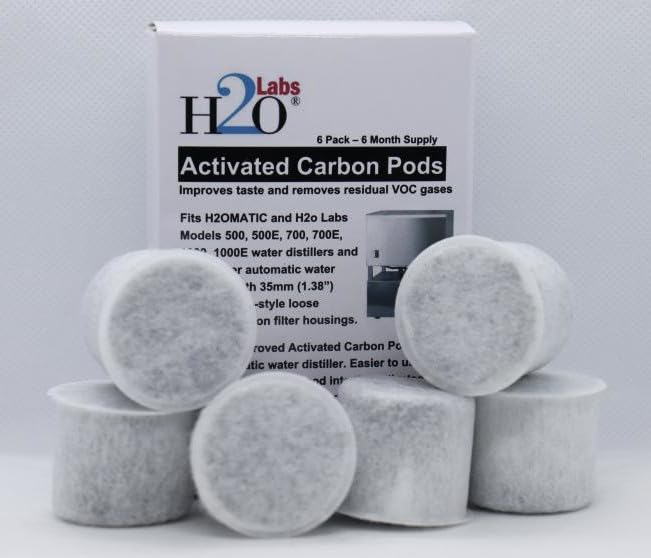
You will need a brass faucet adapter if your sink has a threaded aerator — I found one for $10 at a hardware store. You may also want an extra set of carbon filter pods; the included six will last six months. I recommend these replacement filter pods as a good match for the unit.
The one-year limited warranty covers manufacturing defects but excludes scale damage and normal wear. Customer support responded to my email in 48 hours, and the answer was helpful. You will need to pay return shipping if a repair is needed. The warranty does not cover labor or consumables like filter pods.
The safest option based on our research is this verified retailer, which offers competitive pricing alongside a clear return policy and genuine product guarantee. Avoid third-party sellers on other platforms, as counterfeits of the carbon filter pods are common.
At 800 watts, running the unit for four hours per cycle consumes about 3.2 kWh. At the US average electricity rate of $0.13 per kWh, that is roughly $0.42 per cycle. Producing five gallons typically requires two cycles, so expect $0.84 per day in electricity costs, or about $25 per month with daily use.
Yes. I did this regularly during the test period. The automatic sensors shut off the heating element when the reserve tank is full, and the unit does not restart until water drops below a certain level. I never experienced an overnight issue in seven weeks. Just make sure the inlet hose is securely connected and the vent is unobstructed.
Reviews You Can Actually Use
We test products so you do not have to guess. No sponsored rankings. No filler content. Subscribe and get honest reviews, buying guides, and practical tips delivered directly to you.