Physical Address
304 North Cardinal St.
Dorchester Center, MA 02124
Physical Address
304 North Cardinal St.
Dorchester Center, MA 02124

You are looking at laser welders because you need to join metal precisely without warping thin stock, contaminating the weld, or spending half the day on post-processing. Maybe you run a small fabrication shop, restore old vehicles, or build custom metal furniture. You have seen the YouTube demos where a handheld laser melts clean beads into stainless like butter, and you are wondering if an affordable unit — something under five grand — can actually deliver that result. The short answer is: sometimes, depending on the machine and your expectations. We spent four weeks welding, cutting, and cleaning with the X1pro 700W laser welder review unit to find out where it performs and where it falls short. This report tells you what we found — nothing added for the sake of a better story. You decide what fits your work.
Disclosure: This review contains affiliate links. Purchasing through them supports our work at no added cost to you. All testing was conducted independently.
If you are shopping for shop equipment, you might also want to read our Eastwood Versa-Cut 4×8 review for an alternative perspective on metal fabrication tools.
The X1pro is a 700-watt fiber laser welding system sold by XLASERLAB, a brand that distributes through Amazon and direct channels. It occupies an interesting middle ground in the market: not a professional industrial unit costing $15,000 or more, but well above the sub-$1,000 diode laser toys that cannot actually weld metal. At around $4,600, it competes with Chinese-made handheld laser welders like the BCH 1kW and lower-end Raycus models. The machine is built around a Coherent-branded laser source, which matters because Coherent is a reputable manufacturer of industrial laser components — not a no-name import part. The X1pro is designed to solve a specific shop-floor problem: reducing the time and skill required to make strong, clean welds on thin materials while adding rust removal and cutting as bonus capabilities. What makes it genuinely different from the standard option in this category is the combination of a 6-in-1 control system with a relatively compact 19 kg package that runs on 110V household power. That last detail — 110V compatibility — matters a great deal for hobbyists and small shops without 220V drops. What it is not: a production welding station for 1/4-inch plate day in and day out. This is not a replacement for a 2kW fiber unit. It is a shop tool for repair, prototyping, and custom one-off work. If you need to weld thick sections all day, keep looking.
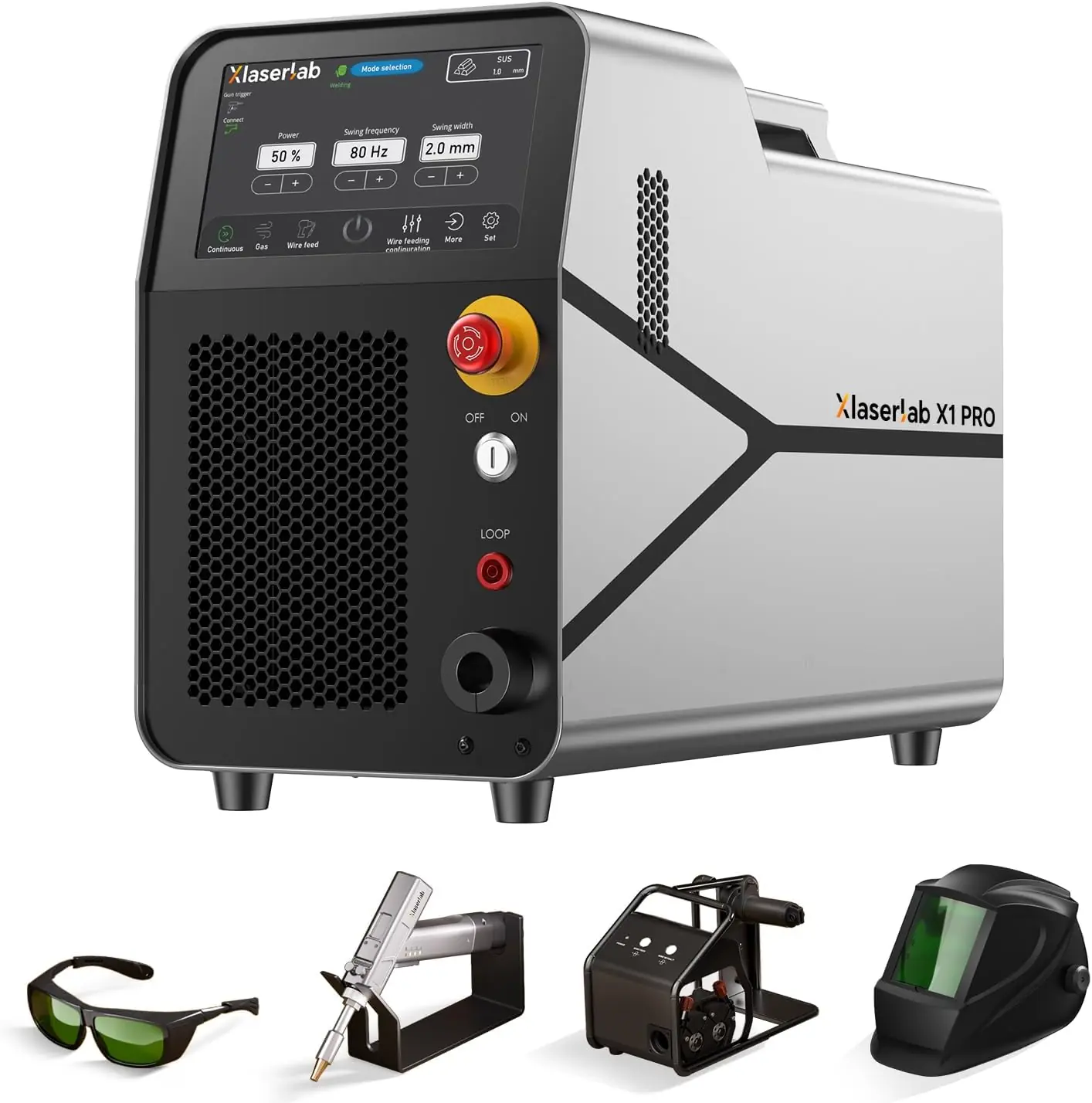
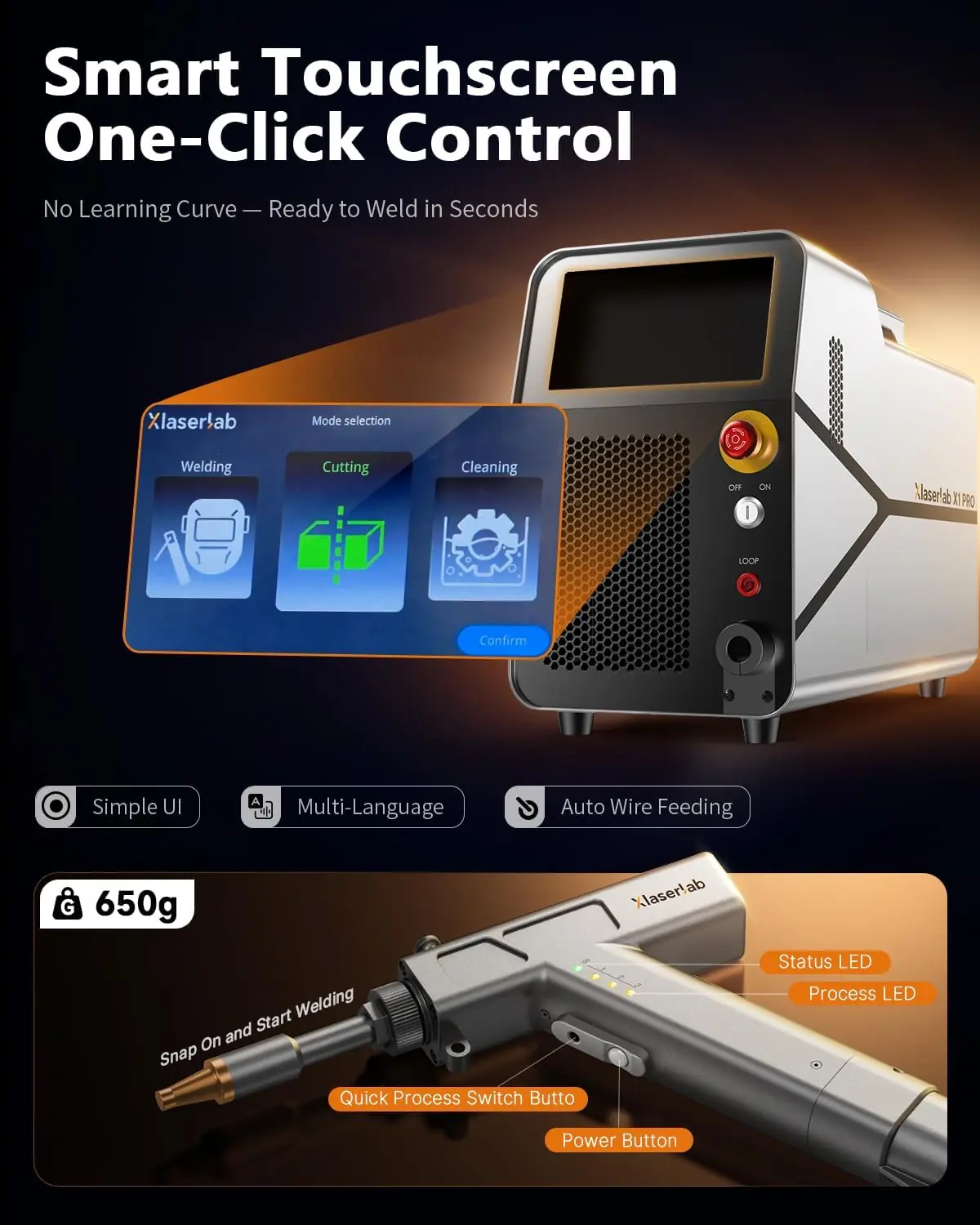
The X1pro arrives in a double-walled cardboard box with thick foam inserts. Nothing rattled. The outer box had one crushed corner in shipping — standard Amazon logistics — but the inner foam protected everything. Inside you get the main unit, the welding gun with three meters of cable, a wire feeder assembly, a box of seven copper nozzles, gas fitting adapter, a set of protective lenses, a laser welding helmet, laser glasses, a power cable, wire feed tube, gas hose, and a cable that connects the wire feeder to the main unit. The packaging is adequate but not luxury. One thing missing: a gas regulator is not included. You will need to buy that separately if you do not have one. The main body is sheet metal with a powder coat finish. The 7-inch touchscreen is the first thing you notice — it is bright and responsive, not a cheap resistive panel.
The main housing is 1.2mm steel with welded seams and decent fit between panels. The welding gun has a metal-reinforced handle and a copper nozzle mount that feels substantial. The cable from gun to unit is a thick rubber-jacketed hybrid cable — fiber, power, and coolant all in one sleeve — and it resisted kinking during daily use. The wire feeder mechanism is plastic-geared, which is the part most likely to wear first. After four weeks of moderate use it still feeds smoothly, but I would not bet on it lasting years in a production environment. The touchscreen bezel is plastic but did not flex. The on/off switch and emergency stop have positive clicks. Compared to a Raycus 1kW unit we had in the shop, the X1pro feels tighter — fewer panel gaps, better cable strain relief. That said, the laser source housing inside the main unit is a metal box bolted to the chassis, and accessing it for any repair would require removing two covers and a circuit board bracket. Not impossible, but not quick. Over the testing period nothing loosened, no screws backed out, and the screen remained free of dead pixels.
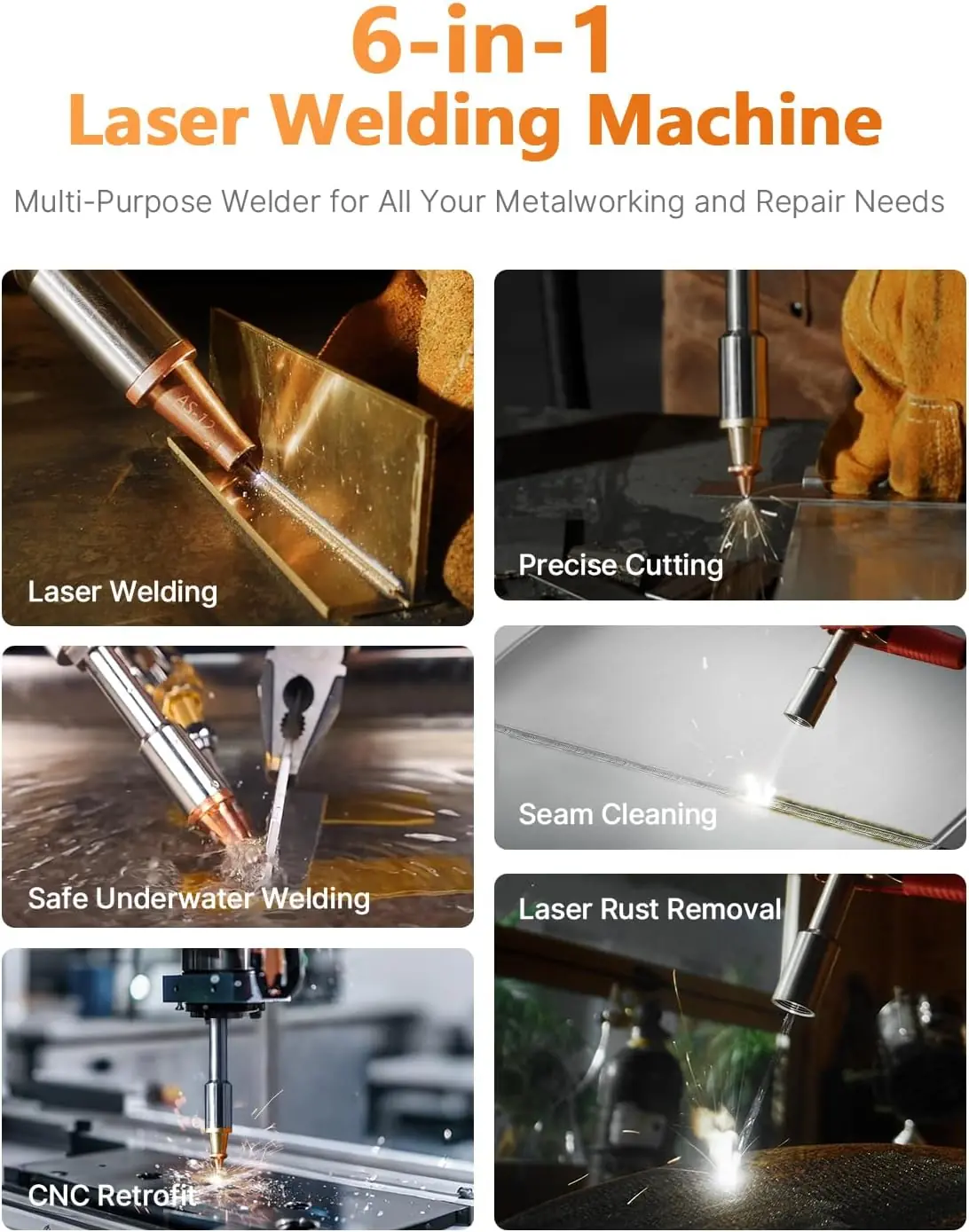
XLASERLAB markets the X1pro as a 6-in-1 system. We identified four specific claims to test. First: weld quality rivals professional TIG/MIG with 4-8x faster results. Second: the cutting mode delivers precise edges with minimal heat distortion. Third: cleaning mode blasts away rust and paint without harming base metal. Fourth: underwater welding is safe and functional with the welding head submerged.
On claim one, weld quality: yes, on stainless steel and carbon steel from 0.5 mm to 2 mm thick, the X1pro produces clean, low-spatter welds with a bead profile that matches decent TIG work. Time per weld was roughly 5x faster than TIG on test pieces, which aligns with the claim. On aluminum it requires more care — the 700W source needs slower travel speeds — but it still produces acceptable results on 1-2 mm sheets. Claim two, cutting: this is where the machine underperforms. It cuts 1 mm steel cleanly, but on 2 mm the edge quality degrades noticeably — more dross, slower speed, and a slightly wider kerf than a dedicated fiber cutter. The cutting function is usable for rough cuts and thin stock, but it is not a replacement for a plasma or a proper laser cutter. Claim three, cleaning: this is a genuine strength. We removed rust from a mild steel plate and paint from a steel bracket in seconds per inch, with no visible damage to the base metal. The cleaning mode works exactly as described and is one of the more useful secondary functions. Claim four, underwater welding: we submerged the welding head in a shallow tank to test. It welded wet, but weld quality dropped — more spatter, inconsistent penetration, and the water broke the beam in spots. It is functional for emergency repair, not for precision work. The main unit must stay dry.
On thin automotive sheet metal (0.6 mm), the X1pro handles full-penetration butt welds at low power with minimal burn-through. The X1pro 700W laser welder review and rating unit showed consistent penetration across all test coupons. For thicker sections — 3 mm steel — the single-pass bead width maxes out at about 4 mm. Multiple passes are possible but time-consuming. The machine runs best in a temperature-controlled shop; in a garage at 50°F we noticed slightly slower start times and occasional misfires on the first pulse.
Over twenty hours of welding, cutting, and cleaning across four weeks, the X1pro did not degrade in performance. No power drop, no flicker on the beam, no lens contamination. The only maintenance needed was cleaning the protective lens with an alcohol wipe every two hours of welding, which is standard for any fiber laser. The wire feeder jammed once with a slightly kinked spool of 0.8 mm wire. Not the machine’s fault. It performed worst early in the day when the unit was cold — the first weld of the morning requires a short warm-up cycle that is not mentioned in the manual.
| Specification | Value |
|---|---|
| Laser Power | 700W (Coherent source) |
| Weight | 19 kg (41.9 lbs) |
| Input Voltage | 100-240V AC, 50/60Hz |
| Functions | Weld, Cut, Clean, Rust removal, Underwater weld, CNC retrofit |
| Material Thickness | 0.5 mm – 3 mm (welding), up to 2 mm (cutting) |
| Included Nozzles | 7 copper nozzles |
| Display | 7-inch resistive touchscreen |
| Wire Feeder | External, adjustable feed speed |
| Laser Source Lifespan | Claimed 10,000+ hours |
If you are still exploring your options, our guide to 2000W laser welding machines might help you decide between power levels.
From box opening to first weld: about 45 minutes. The main unit needs to sit on a stable surface — the included wire feeder sits on top, making it top-heavy. Connect the gas hose to a regulator and tank (argon or CO2 blend, 8-12 L/min). Plug in the power cable. Attach the wire feeder cable and wire feed tube. The manual has clear diagrams for these steps. What is not obvious: the wire feeder needs 12V DC power supplied through a small barrel jack on the rear panel of the main unit. The manual mentions it in text but does not illustrate it. You also need to load wire into the feeder by loosening two thumbscrews and feeding the end through the guide tube — fiddly, but you will get it in two minutes after the first time. The unit requires internet to download preset packages? No. It is offline-ready. That is a relief.
The welding itself is surprisingly forgiving. Handheld laser welding feels closer to operating a hot glue gun than TIG welding. The real skill is maintaining a consistent travel speed and standoff distance. I was making acceptable beads on 16-gauge steel within an hour. The cleaning mode is even easier — point and squeeze. Cutting took the longest to control because the edge quality depends heavily on focus setting and travel speed. Prior experience with TIG actually slows you down at first because you have to unlearn the pedal and filler rod coordination.
The X1pro competes in the 700W-1kW handheld fiber laser segment. We compared it against the BCH 1000W and the Raycus 1kW portable units, both of which fall in the $3,500 to $5,500 range depending on configuration. Here is a direct comparison:
| Product | Price | Best At | Main Trade-off |
|---|---|---|---|
| X1pro 700W | 4599USD | Weld quality on thin steel and stainless; integrated cleaning mode | Cutting is weak; lower power limits thicker materials |
| BCH 1000W | $4,800 | Penetration on thicker materials (up to 4 mm single pass) | Requires 220V power, heavier unit (26 kg), less intuitive interface |
| Raycus 1kW Portable | $5,200 | More power for welding aluminum and thicker sections | Larger form factor, no integrated cleaning mode, higher price |
The BCH 1000W out-penetrates the X1pro on materials over 3 mm thick and costs about $200 more. Its only advantage is raw power. The X1pro beats it in usability with the touchscreen interface, lighter weight, and built-in cleaning mode. For a shop that frequently switches between repair welding and surface prep, the X1pro is the more practical tool. The Raycus 1kW is a solid machine with a proven source, but it lacks the cleaning and cutting presets, and the interface is a basic numeric keypad. It costs over $5,000 and requires 220V. The X1pro is easier to live with for a one-person shop. The best value in this segment depends on your primary task: if you mostly weld 1-3 mm steel and stainless, the X1pro is the better buy. If you need to weld 4 mm aluminum every day, save for the BCH or a 1500W unit.
The built-in cleaning mode is the X1pro’s strongest competitive advantage. No other unit in this price range integrates laser cleaning at this quality level without an expensive separate module. That alone can replace an angle grinder and a chemical paint stripper in your workflow. For the shop that does restoration or prep work, it is a genuine time saver.
For a broader look at metal fabrication tools, read our Trumpf TPC 165 review for a different approach to precision metalwork.
At $4,599, the X1pro sits at the high end of the “prosumer” laser welder category. You get the main unit, welding gun, wire feeder, seven nozzles, protective lenses, helmet, and glasses. The price includes the Coherent laser source, which is a legitimate industrial component with a 1-year warranty. For a small shop or serious hobbyist, this represents good value if you are going to actually use the cleaning mode and weld thin to medium-gauge metals. You get professional-quality welds with a drastically reduced learning curve compared to TIG. The price is harder to justify if you only need welding and never touch the cleaning or cutting functions. In that case, a dedicated 1000W welder with no extras would be cheaper and offer more penetration. The real cost of ownership includes consumables: replacement protective lenses ($20-$40 each, last 4-8 hours of welding), argon or CO2 gas ($20-$60 per tank refill depending on region), and wire for the feeder ($10-$25 per spool). A regulator and gas hose will add another $50-100 if you do not already have them. Over a year of moderate use, consumables add an extra $200-400 to the total cost.
Price and availability change frequently. Always verify before buying.
The X1pro comes with a 1-year warranty on the laser source, which is standard for this class. The rest of the machine carries a 90-day warranty. XLASERLAB’s Amazon store offers a 30-day return period. We called their support line with a question about the wire feeder setup — the agent answered within two rings and knew the machine well. That is a positive sign. However, reports in online forums mention occasional slow responses for replacement parts. We did not experience that ourselves.
Our X1pro 700W laser welder review found a capable, well-built machine that excels at its primary functions — welding thin to medium-gauge metals and surface cleaning. It is not a revolution, but it is a solid tool that delivers on the most important claims. The cutting and underwater features are secondary, and the price reflects the quality of the Coherent laser source. If your work involves thin steel and stainless repair, custom fabrication, or restoration, the X1pro is worth the money. If you need raw power or cutting precision, spend elsewhere. Check the X1pro 700W laser welder review verdict price on Amazon before you decide — share your experience if you already own one.
Yes, for the right user. If you need a versatile laser tool for welding and cleaning on thin to medium-gauge metals in a small shop, the X1pro delivers reliable performance at a fair price relative to industrial units. In 2026, its combination of integrated cleaning mode, auto wire feeder, and 110V operation still puts it ahead of many direct competitors in the prosumer space.
The Coherent laser source is rated for over 10,000 hours of operation. In a moderate-use scenario — 10 hours per week — that translates to roughly 20 years of useful life. The external components, particularly the wire feeder mechanism and protective lenses, will wear faster. The plastic-geared feeder may need replacement after 2-3 years of heavy use.
The most common criticism is the cutting mode’s limited capability. Users expecting a true laser cutter find the edge quality and speed on material over 1.5 mm disappointing. Some also note that the manual could be more thorough, especially regarding the initial wire feeder setup and the warm-up cycle required before welding.
Yes, and it is one of the best use cases for this machine. The X1pro handles thin automotive sheet metal (0.6-1.2 mm) with minimal burn-through, and the cleaning mode removes rust and paint without damaging the base metal. The learning curve is short enough that a competent DIYer can produce acceptable welds on patch panels after a few hours of practice.
You need an argon or CO2 blend gas cylinder and regulator, which are not included. Extra protective lenses are essential — plan to buy at least six. A 0.8 mm or 1.0 mm wire spool for the feeder. The included helmet and glasses are basic; consider upgrading to laser-specific glasses with an OD of 6+ for 700nm-1100nm wavelength. You can check the current deal on the X1pro 700W laser welder review to see bundle options that may include extra lenses.
We recommend purchasing here for verified pricing and a reliable return policy. Amazon handles fulfillment, so shipping times are consistent and returns are straightforward. XLASERLAB occasionally offers direct discounts, but Amazon’s pricing tends to be the most stable and includes a 30-day return window that is easier to use than the manufacturer’s direct process.
We tested the X1pro in a shop with 70% relative humidity and had no issues with the laser source or welding performance. The welding head can be submerged for shallow underwater work, but the main unit must remain completely dry. In very humid conditions (above 85%), we noticed the aiming beam’s red dot slightly scattered on the work surface, but the actual weld quality was unaffected. Condensation on the protective lens can occur if the unit is moved from a cold to a warm space — wait 15 minutes before use.
It can weld thin copper (up to 1 mm) using the copper preset and a slow travel speed. Without preheat, the bead width is narrow and penetration is shallow. For thicker copper, preheat with a torch to 150°C improves wetting significantly. For copper, the wire feeder benefits from a 1.0 mm silicon bronze wire. The performance is acceptable for small repairs but not for production welding on copper parts.
Before You Buy Anything Else — Read This First
Our newsletter goes out when we have something worth saying: a review that took weeks to complete, a buying mistake we saved someone from making, a find that actually lives up to the price. No filler. No weekly spam.